1 General Information
1.1 Purposes
This User Manual introduces the DEEPSITE Document Insighter system including the interface and management functions to help users quickly log in, browse and use this system. And provide you with solutions to the problems encountered in the use of the system and how to access the resources and help.
1.2 System Overview
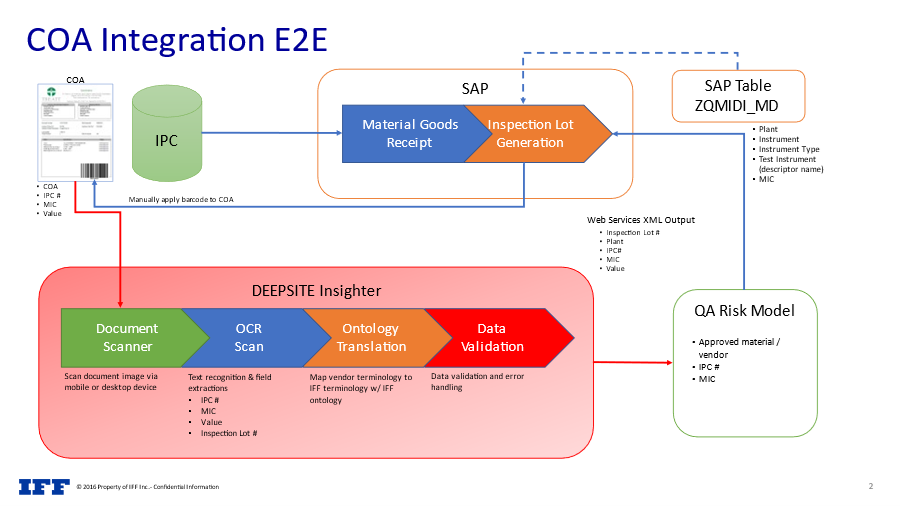
Document Insighter is a digitizing solution with AI-Powered Advanced Content Intelligence that can be quickly consumed as a service providing the ability to carry out a task like reading a document, digitizing an image or a table, extracting data interested, or any other tasks related to understanding and processing content as well as analyzing data. Document Insighter also provides auto validation/ontology against with the data from user’s database such as enterprise SAP using the extracted data from documents. In addition, Document Insighter supports user feedback and continuous learning to improve precision via the cloud-based portal.
2 Getting Started
2.1 Logging on
After clicking the jump icon in oFlow or enter the URL https://document-insighter.godeepsite.com to see the login website as shown:
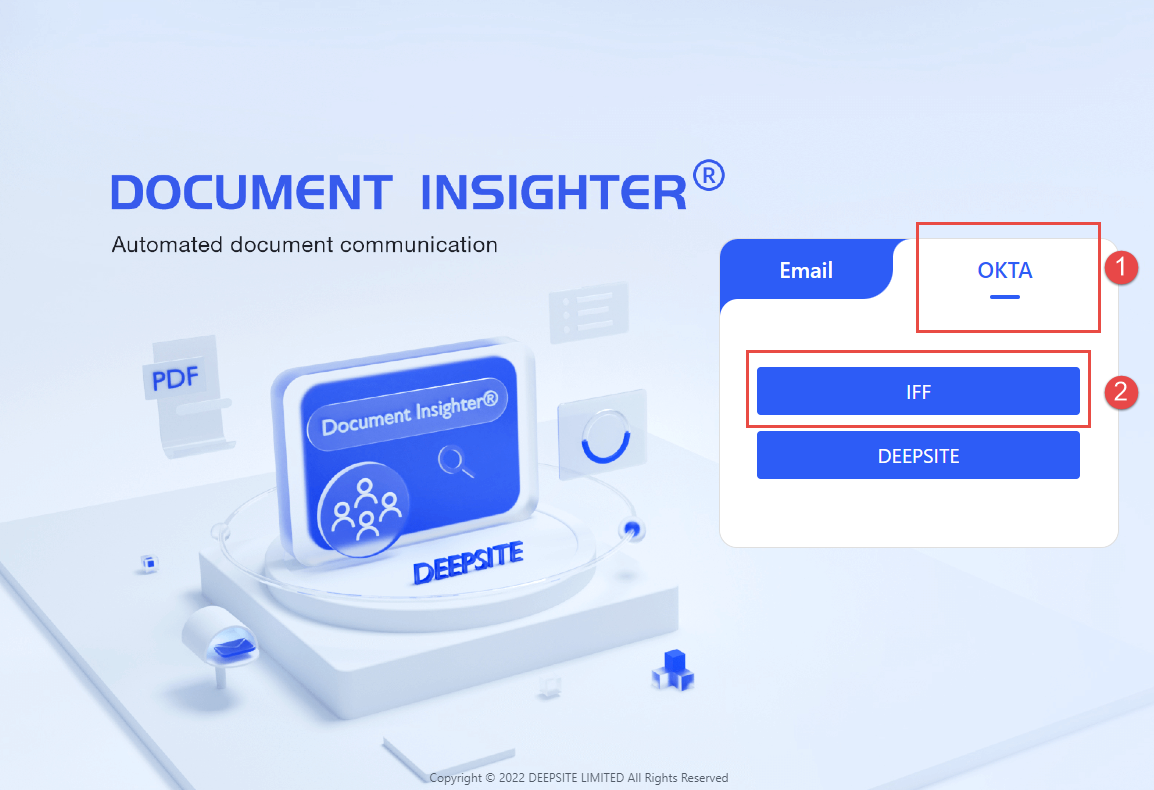
Users can log in the DEEPSITE Insighter portal by clicking button ① “OKTA” and choosing “IFF” and then typing in their authorized account name and password
2.2 Role Types
Users belonging to different role types will have different permissions:
| Role Type | Access | User Profile | Permission Level |
|---|---|---|---|
| Viewer | view access site | users/technicians | default |
| Contributor | edit/contribute access | super users | restricted |
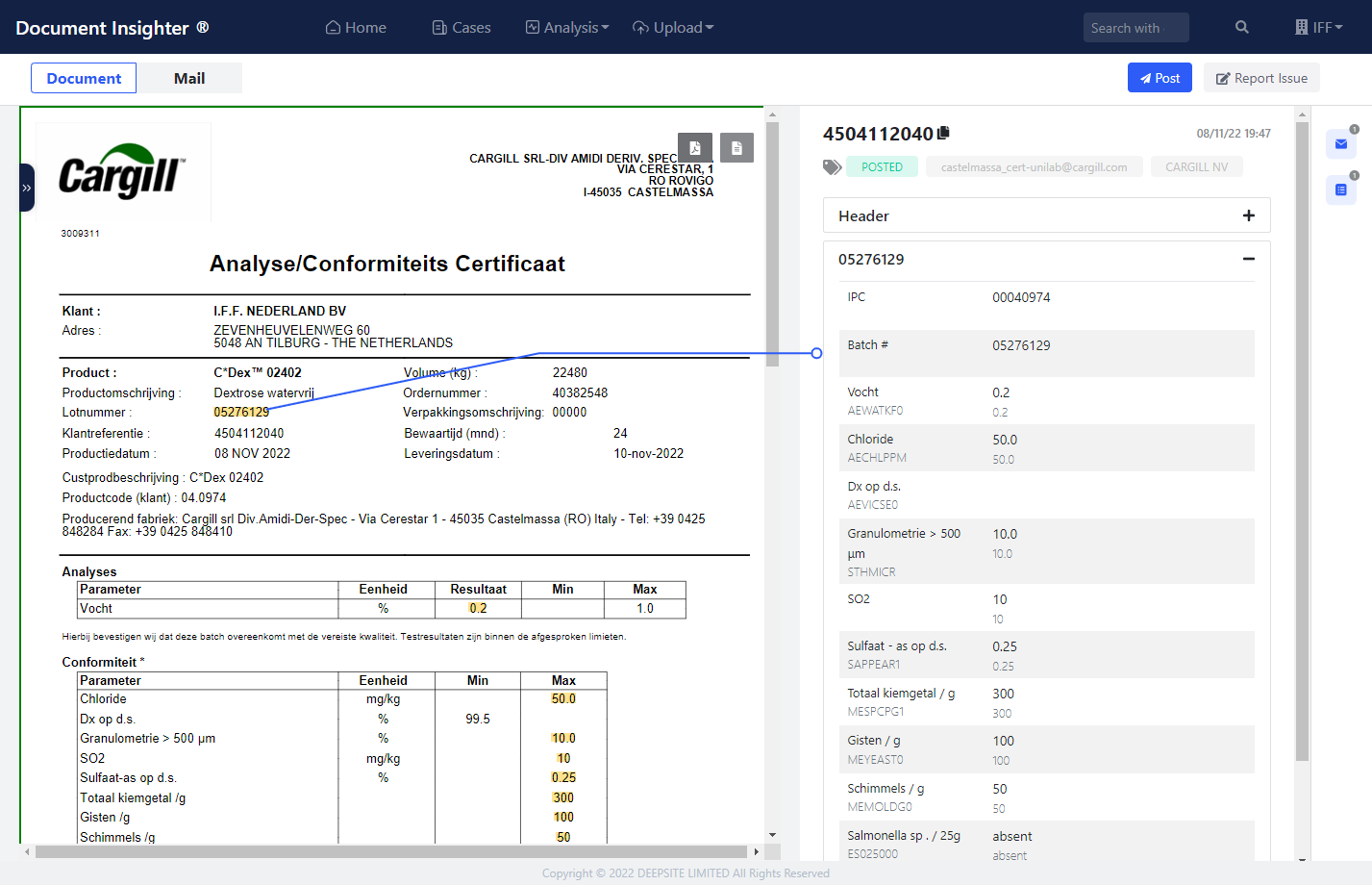
Viewer can access the portal/interface (read only) as shown in the figure below:
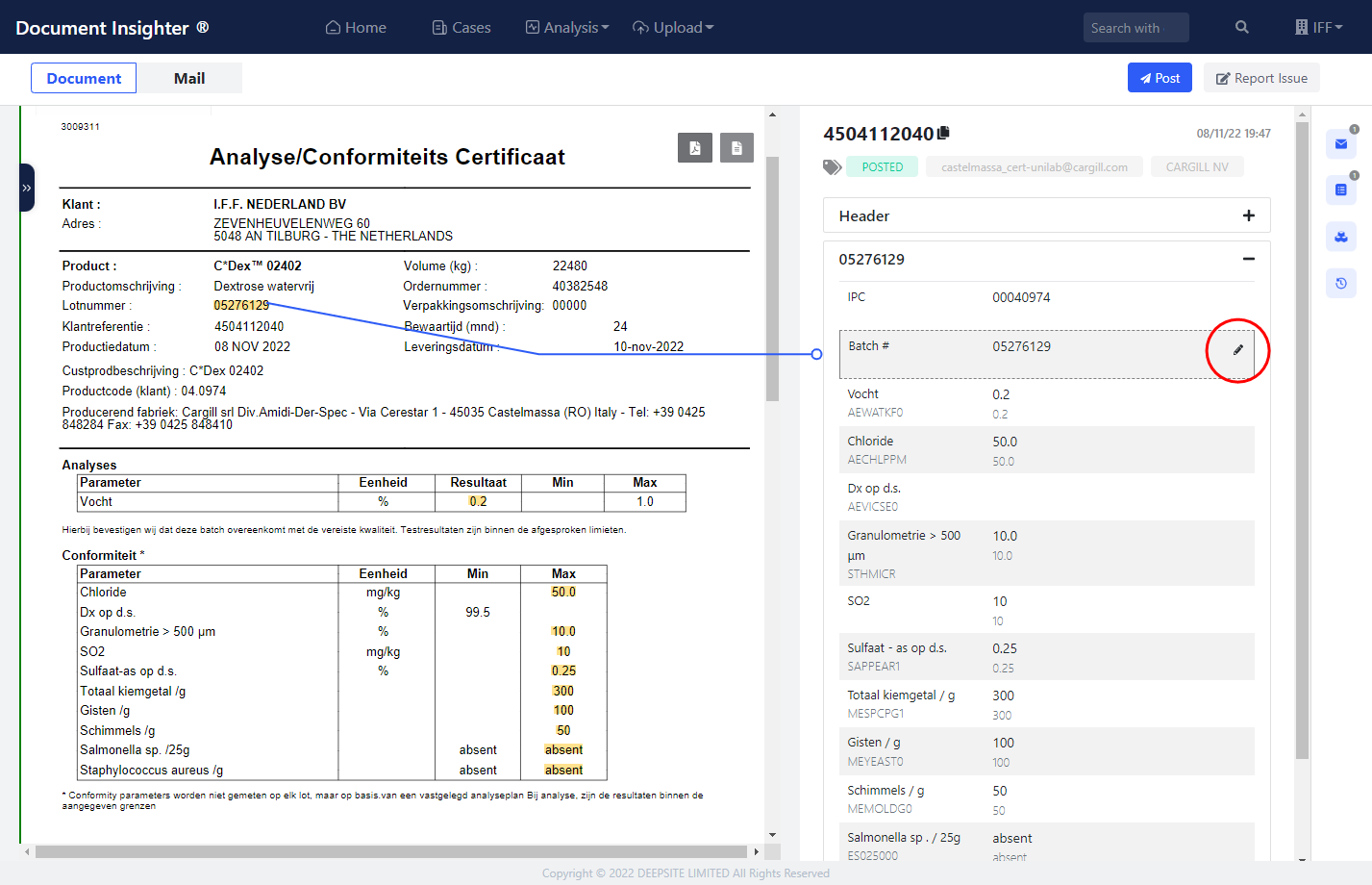
Contributor can access the portal/interface and edit the extracted value as shown in the figure below:
2.3 Homepage
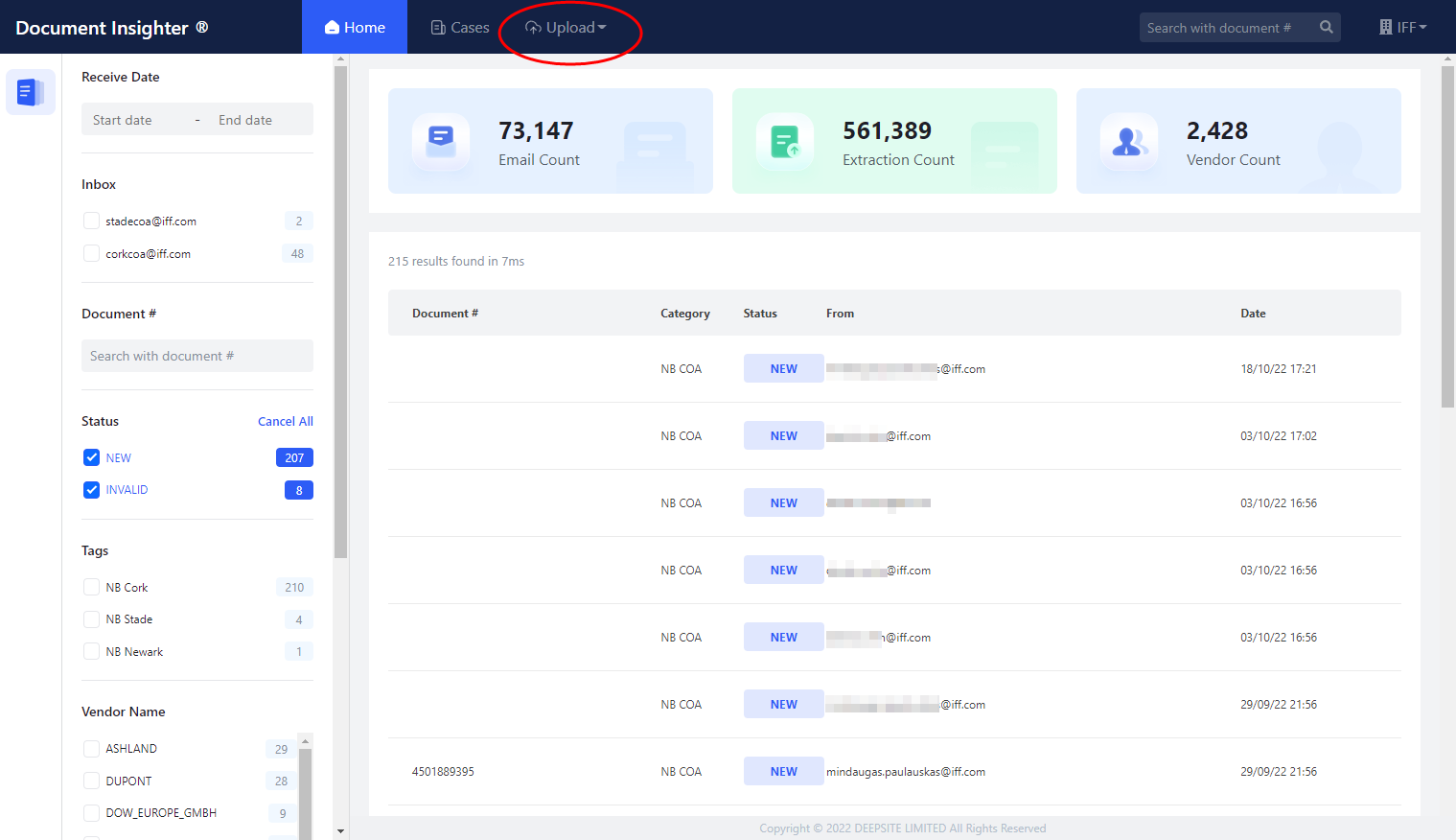
The system can archive data automatically with convenient and rich search capabilities. After logging in, click the “Home” button in the top ribbon to enter the home page, as shown.
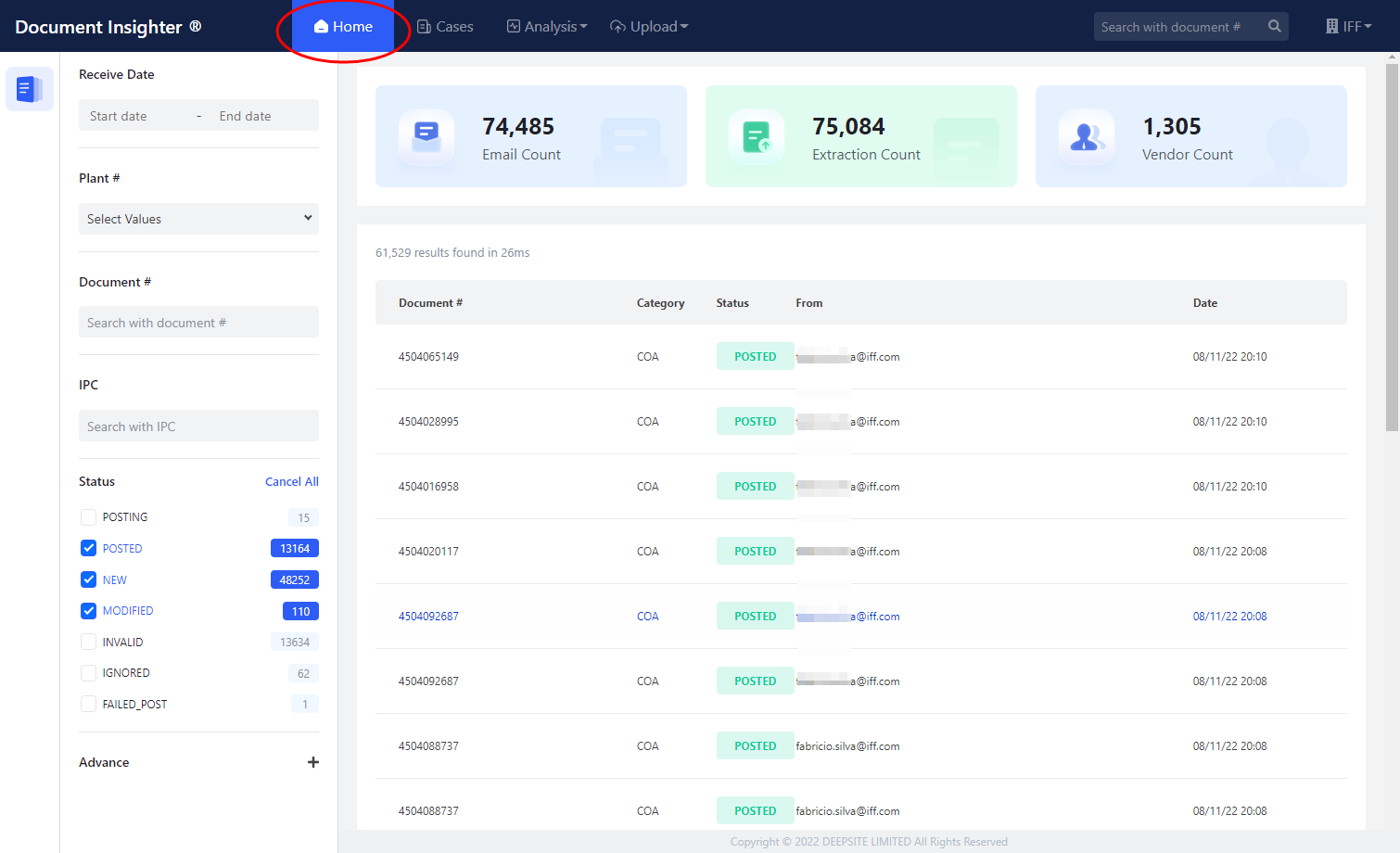
The left filter function bar provides users with more detailed classification and filtering functions:
- “Receive Date”: The email received date or uploaded date.
- “Document #”: The number of OCR document, like PO number.
- “Plant #”: Filter all the extractions by IFF Plant ID.
- “IPC”: Filter all the extractions by IPC.
- “Status”: Following up status such a “Posted”, “Modified”, etc.
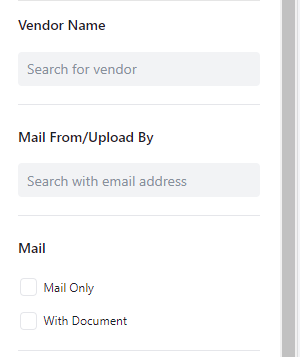
- “Vendor Name”: Filtered by vender name.
- “Mail From/Upload By”: Filter all the extractions by User’s email address.
- “Mail/Document”: Filtered by the type of COA(only email or email with documents attached).

2.3.1 Quick Search Area
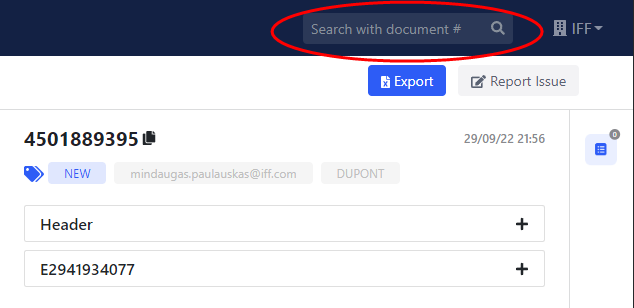
Users can quick access the search function at the top ribbon. After entering the PO number here, it will jump to the corresponding review page.
2.4 Review Page
2.4.1 Display and download the original documents and email
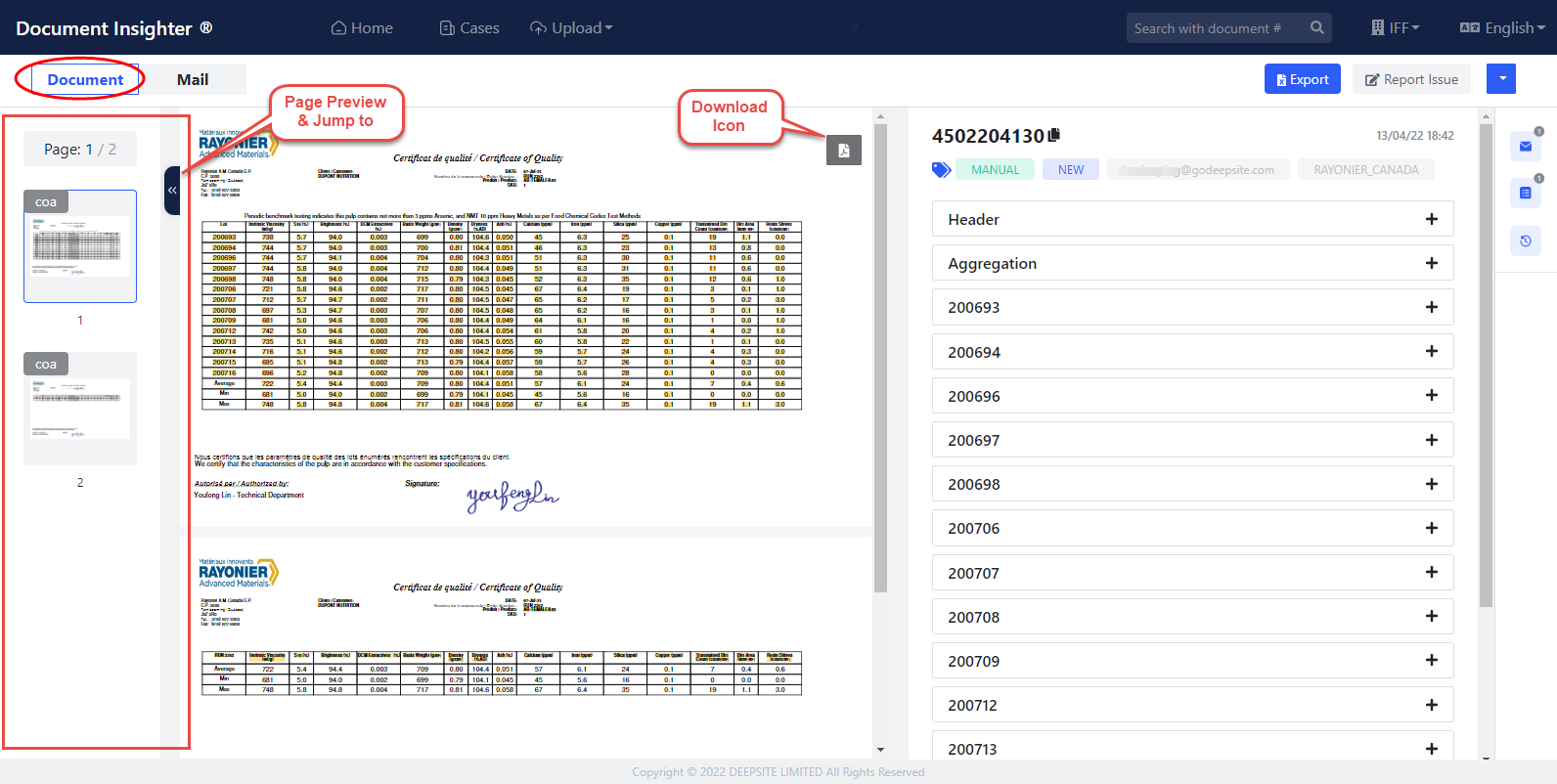
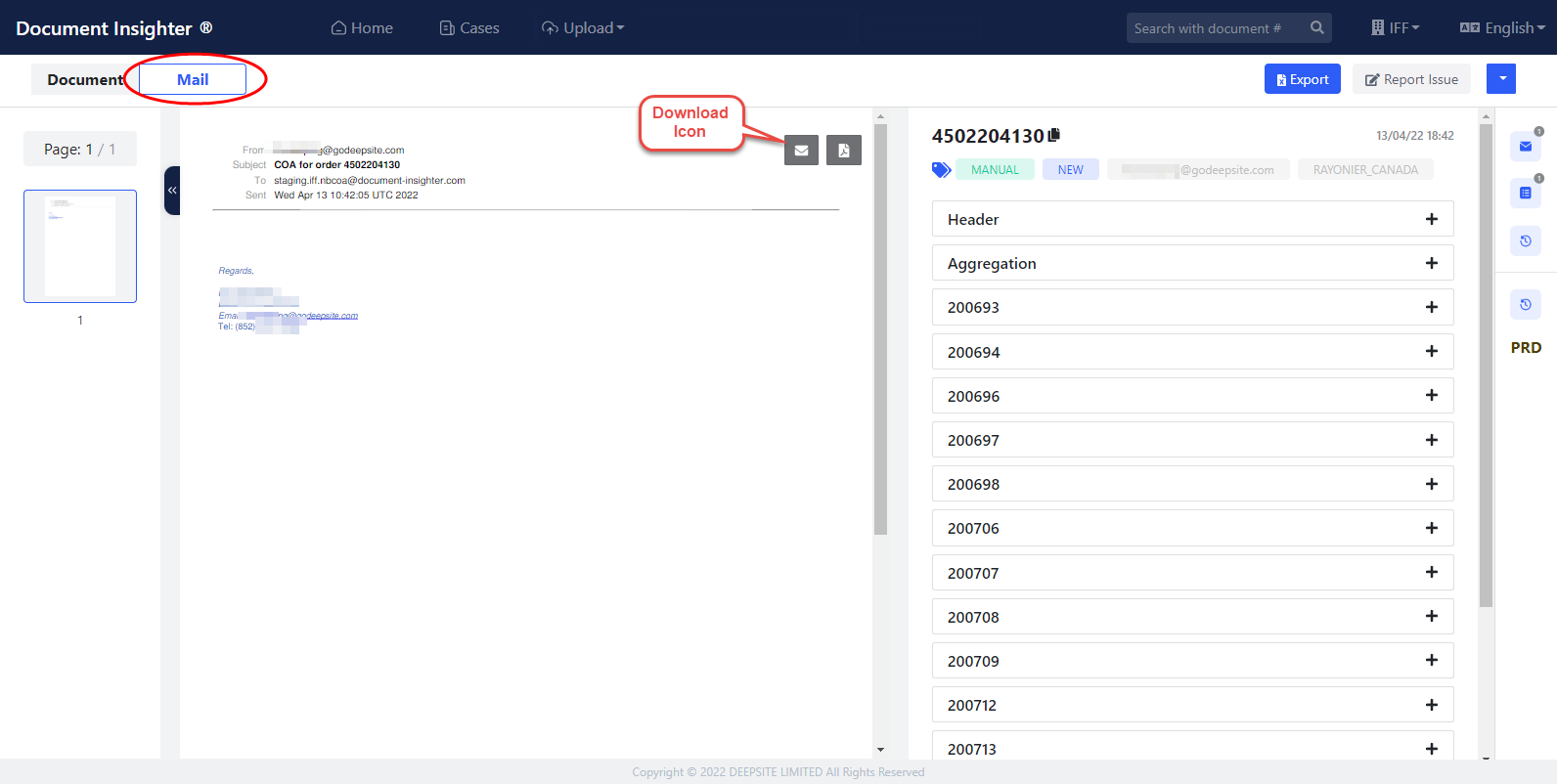
After logging in, the COA document if existed and email will be shown in the left side of the page. User can also down the PDF version of the document file or the eml version of the email by clicking the download button.
2.4.2 Extracted Result Display
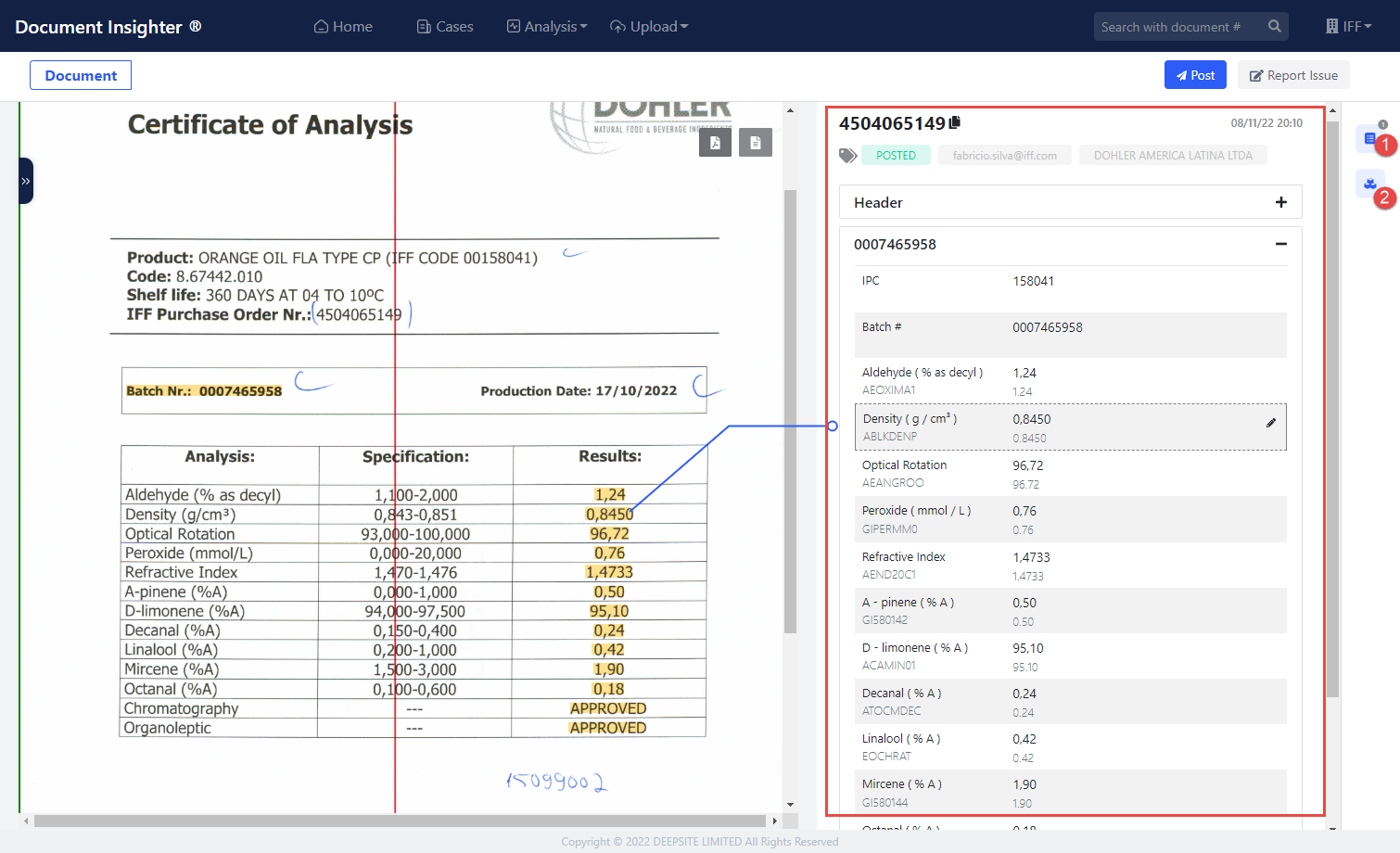
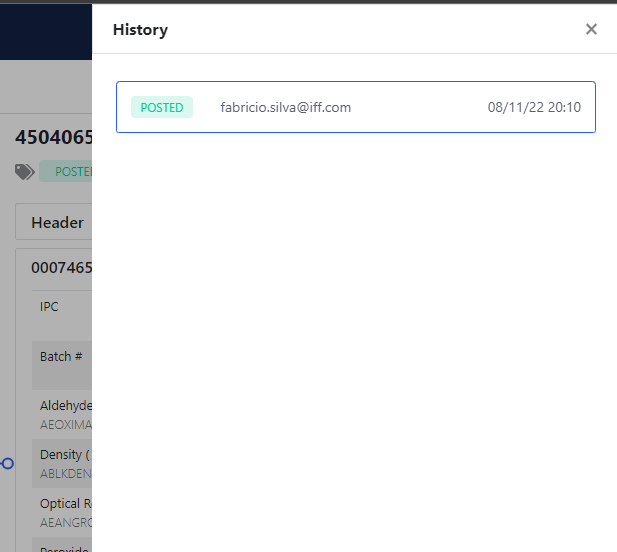
The extracted data will be shown in the right side of the page including Test parameter results and mapped Spec codes. Clicking the button ① in the following picture will display the historical extracted records of the COA:
Clicking the button ②, it will display the material/IPC’s PLM_VQDI_IPC_SPEC data.

2.4.3 Multiple Orders/IPCs/Batches Case Support
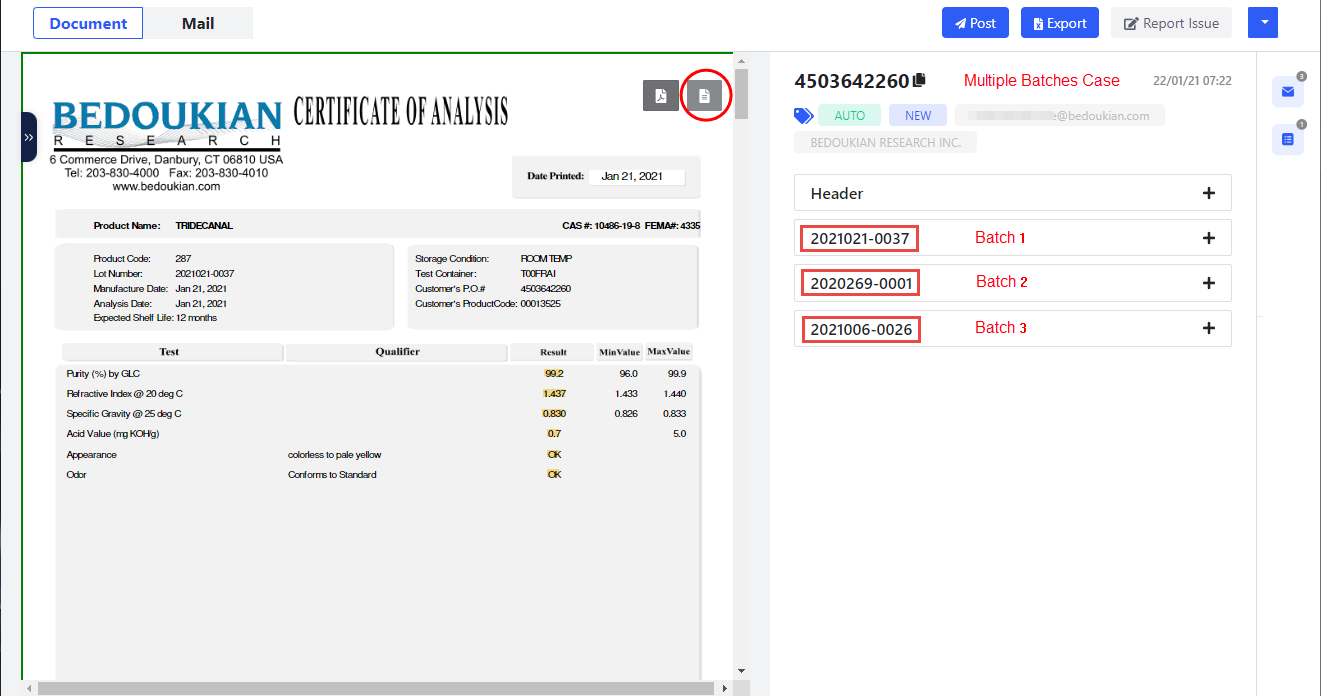
After the system enhancement and upgrating, Document Insighter supports users email or upload COA documents with multiple batches/IPCs/orders/PDF files in a mail now. The system will divide the extraction results from the same email but different orders into different extractions and presented separately on the portal.

Click the button ①, user can reveiw all the extractions from different orders but in one email. Click the button ②, the pdf document browser window on the left will automatically jump to the current extraction(current order) and highlight the corresponding pages.
2.4.4 Ontology Result
The contents in the following picture with the red box show the extracted test parameters in vendor’s COA document. Our ontology engine will map it to the IFF MIC SpecCode automatically.

2.4.5 Extraction Validation
Before posting the result to SAP, the system considered three main factors to do the validation: PO #, IPC # and Batch#. The following diagram shows the validation logic:

Users can find all the archived “Invalid” mails in the portal homepage through the Status Filter:
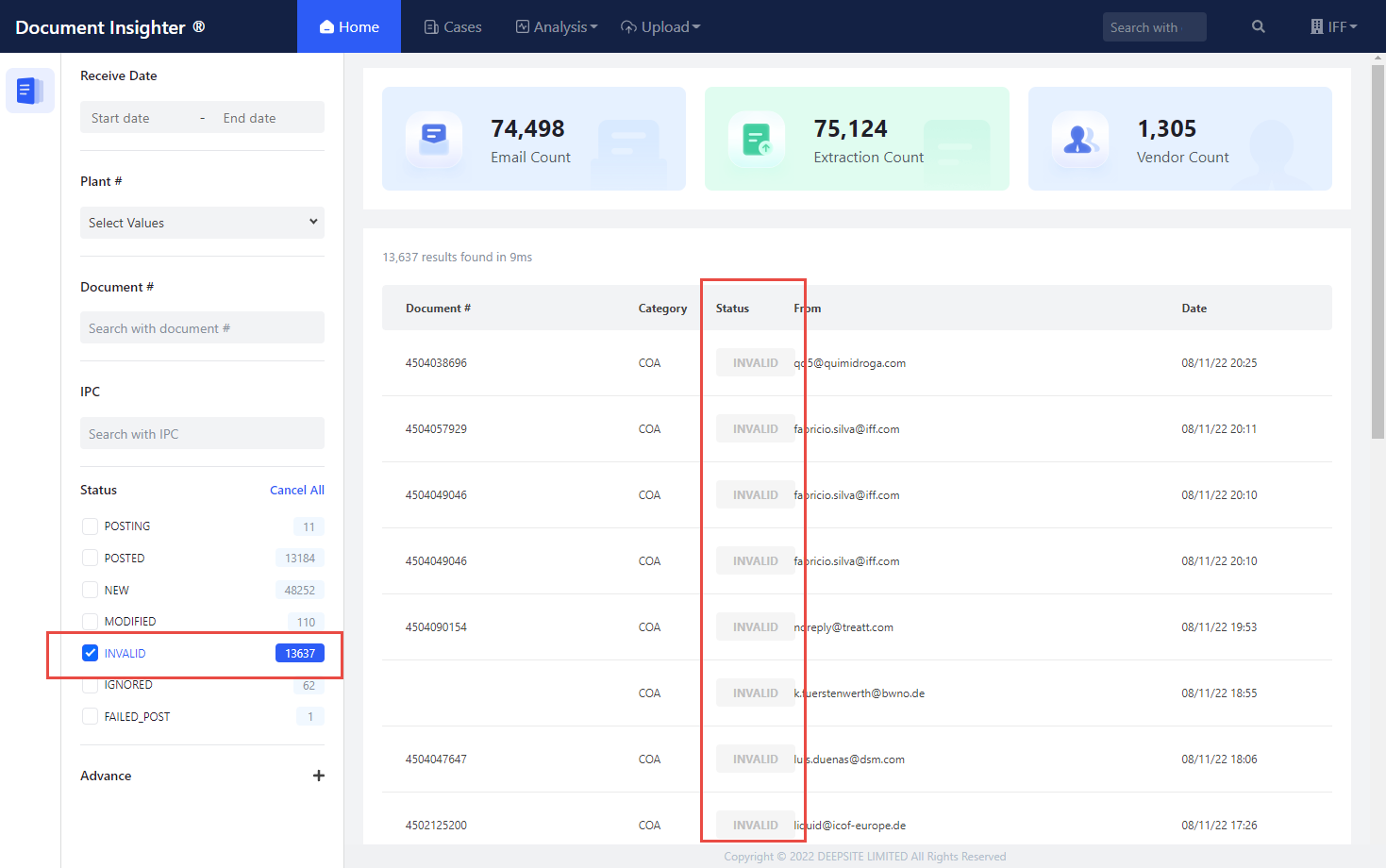
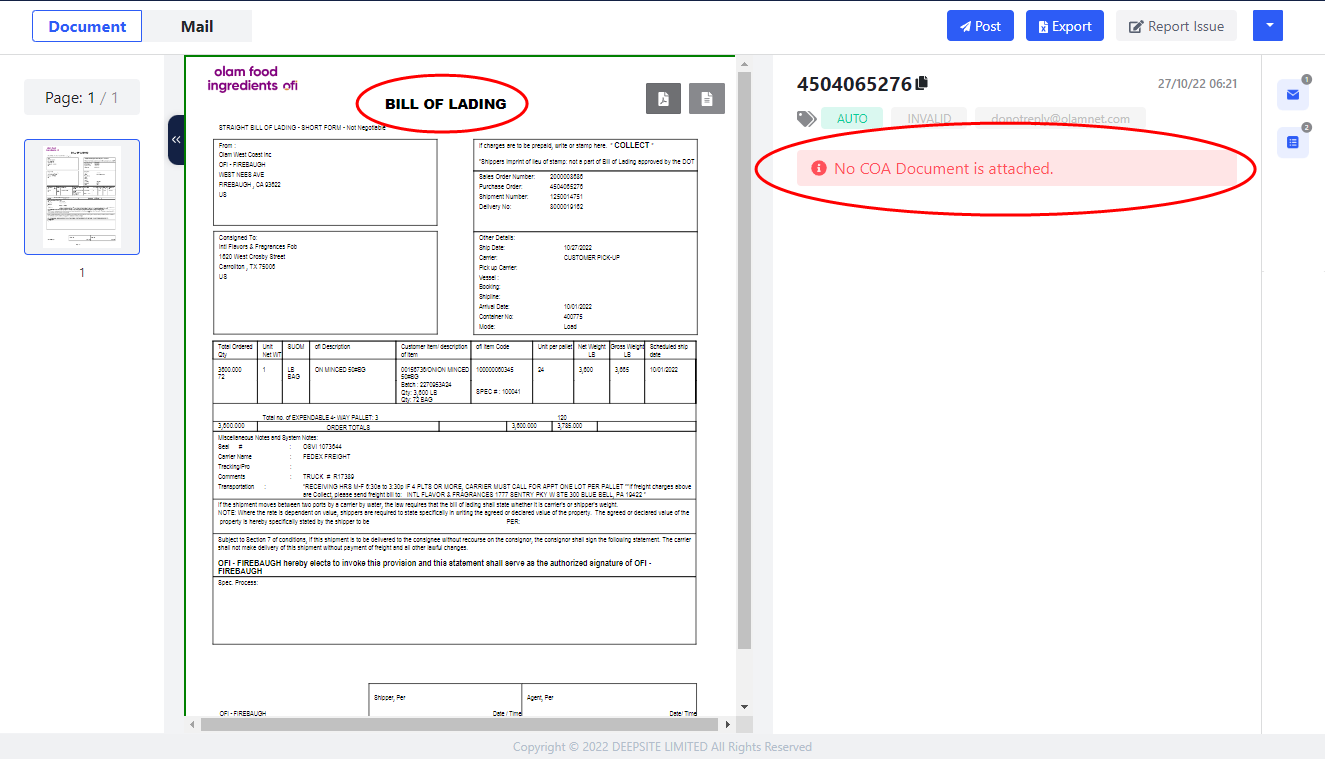
Click the extraction to enter the review page, then the specific Error Message shows at the top of the “Text Result” in red, which include the following possible cases:
- No PO number found.
- No Batch number found
- No IPC number found
- No COA Document is attached.
2.4.6 Post to SAP Validation
The system also supports customized result validation and converting before posting to SAP, these features include:
- Number format converting Some vendors may use different number format such as “1,234.56”, “1.234,56” or “.78”, the system will convert these number to a SAP acceptable format and then post them to SAP.
- Unit Validation for Quantitative MICs For the Test Parameters, vendors may use different unit to show the test result, the system will check the consistency with IFF MIC Master Data. If it is not identical, an er ror message like “UOM ‘mg’ not match ‘kg’” will be posted to SAP together with the extraction result.
- Result Validation for Qualitative MICs According to the MIC_Selected_codes, the system will validate the result of each mapped Qualitative MIC. After validation, transform the result to SAP acceptable format, for example: “Complies” –> “Pass Confirm to Standard”
2.5 Main Functions
2.5.1 Revise and Repost
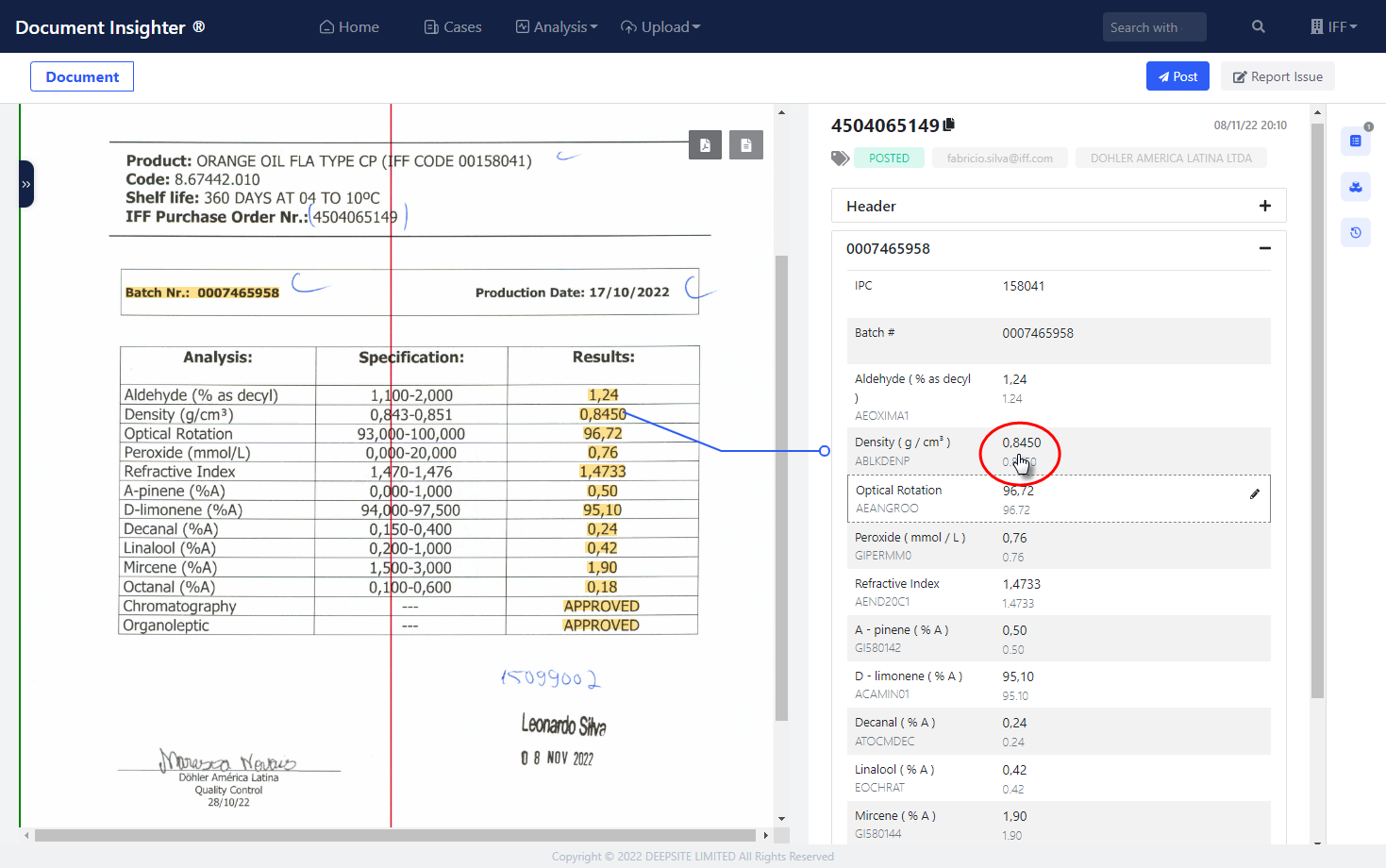
When user click the extracted data, the system will highlight the related text in the document in blue color to help user check the result quickly.
2.5.2 Revise Extracted Results
User can open the edit panel to revise the extracted reuslts by clicing the edit icon.
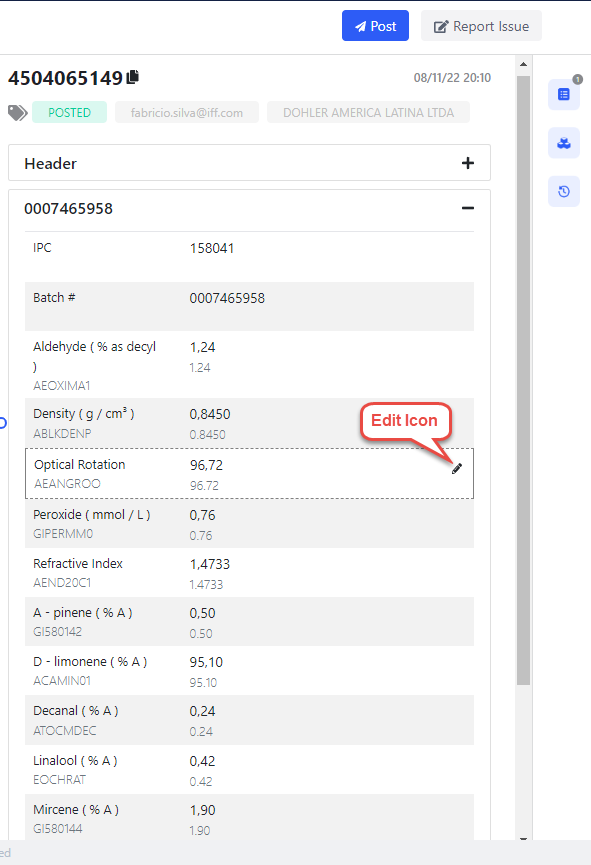
User can change the default mapped code to others if it is not correct or just leave it blank if it is not the critical one, also can revise the test value extracted.
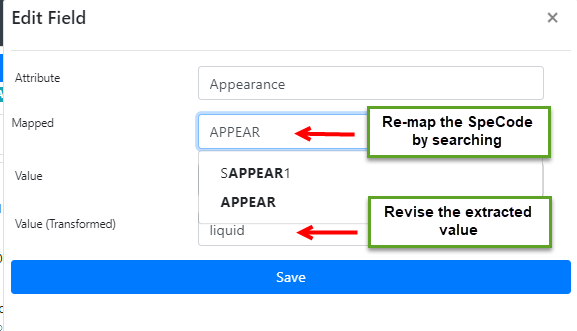
After clicing the “Save” buttton, there will be a green ticker icon appeared behind the item user edited before. When you hover the mouse on the icon, it will show the last revise record information.

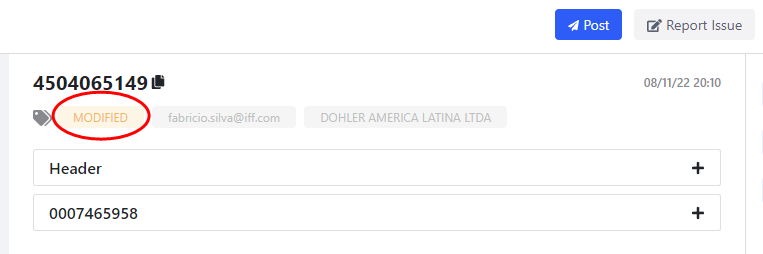
Once the modification has been stored, the status will be changed from ‘New’ to ‘Modified’. And the system will repost the revised result to the SAP automatically.
2.5.3 Issue Report
For most cases, even in some new formats, our A.I. engine can automatically detect and extract the tables and data points that users are interested in. For some processing failure cases, the system needs to collect samples in order to finetune the model and continuously optimize model performance. The system will collect user feedback on extraction issues in the following ways:
- Send email directly to support@godeepsite.com for issues like:
* Cannot access the Insighter web portal
* Insighter system related question or queries
* Or other general issues- Report issue for a specific COA document:
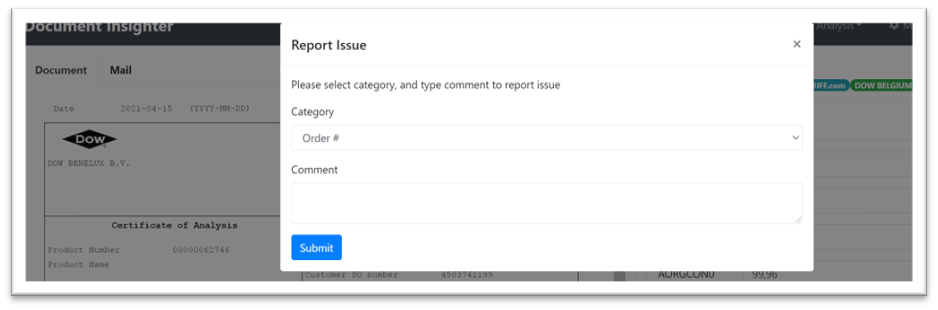
Report issue manually by clicking the “Report Issue” button. Pick an issue category, like “IPC/Extraction” and leave your comment in the dialog.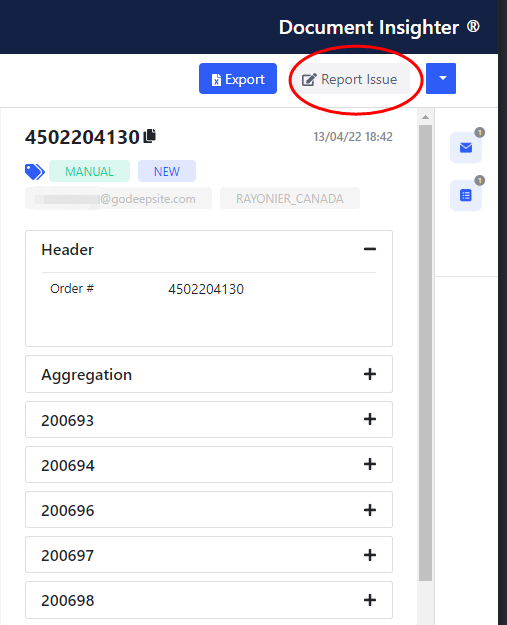
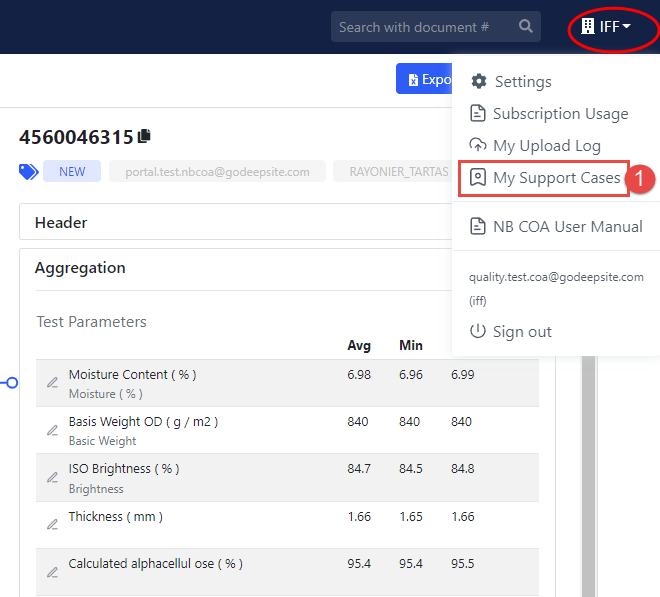
- Users can check the status of following up and review all the support cases/issues they reported by clicking the button ① to open the “My Support Cases” page.
* The system will forward this issue to our Technical Support team, the team will follow up on the issue, and update you within 4 days.2.5.4 Validation Analysis
Clicking the “Analysis” button, the system will provide the results based on existing data analysis, including vender performance and mic performance(need the Management User Role granted first).

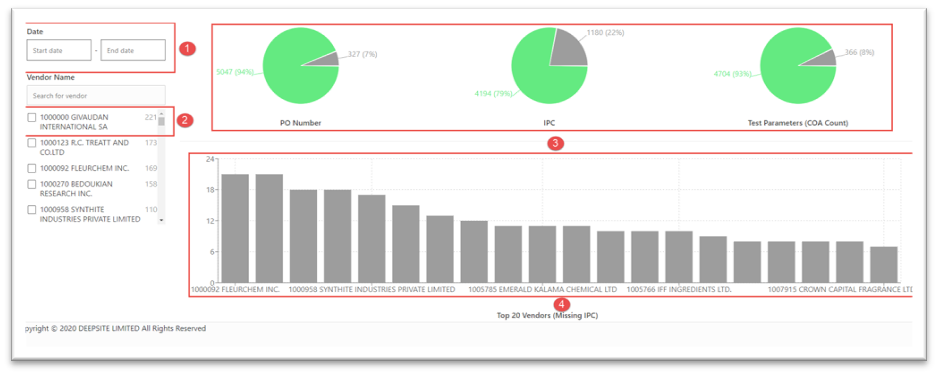
COA Vendor Performance:
- ① filter the performance results by date
- ② filter the performance results by vendor
- ③ Online statistical pie charts for:
- Missing PO or* IPC cases
- No Test Parameter found
- The proportion of failures of MIC ontology
- ④ Top 20 vendors, we cannot extract IPC number (not exist) in their COA documents.
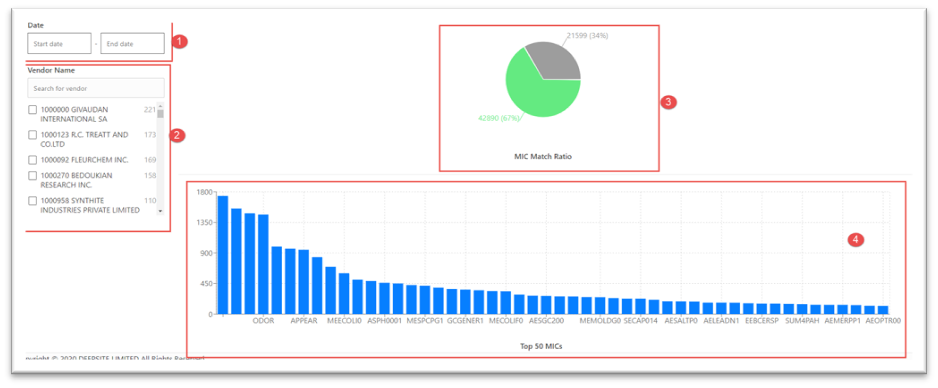
COA MIC Performance:
- ① filter the performance results by date
- ② filter the performance results by vendor
- ③ The proportion of the cases that the map/ontology cannot match to the appropriate IFF MIC specCode in all of the samples showed in the pie chart.
- ④ Top 50 MICs, which system can not map them to the IFF MIC specCode.
3 Process for Manually Uploading COA
The system support users upload the COA document manually through the following methods:
- Scan the document by desktop Scanner and send to COA processing mailbox
- Scan the document by MS Lens or MS Office Mobile App and share to COA processing mailbox
- Upload the PDF version of COA documents via the Insighter portal upload function
3.1 Uploading via MS Lens
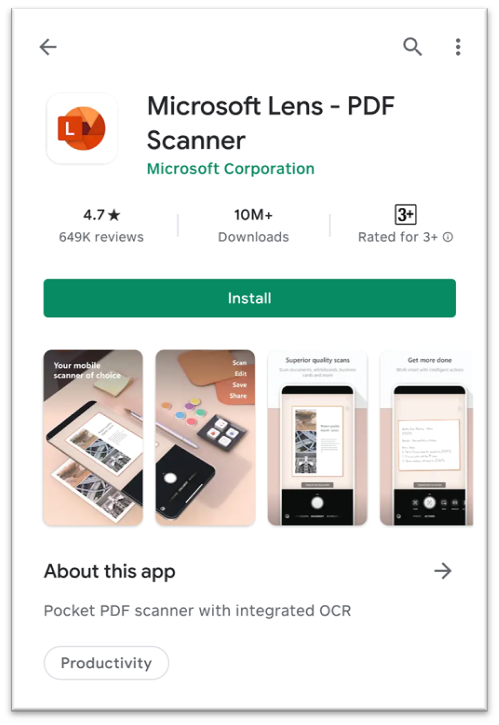
Users can install the Microsoft Lens in the iOS or Android App store, and here are MS official User Guide for reference:
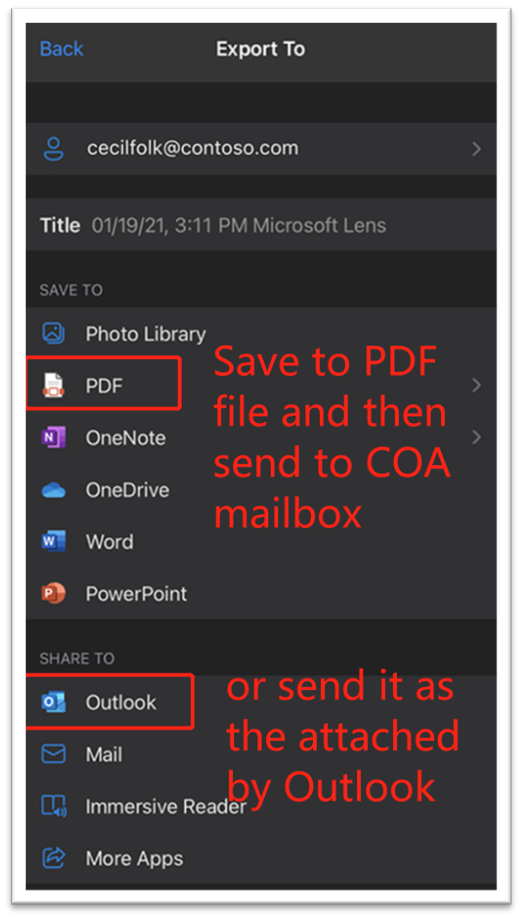
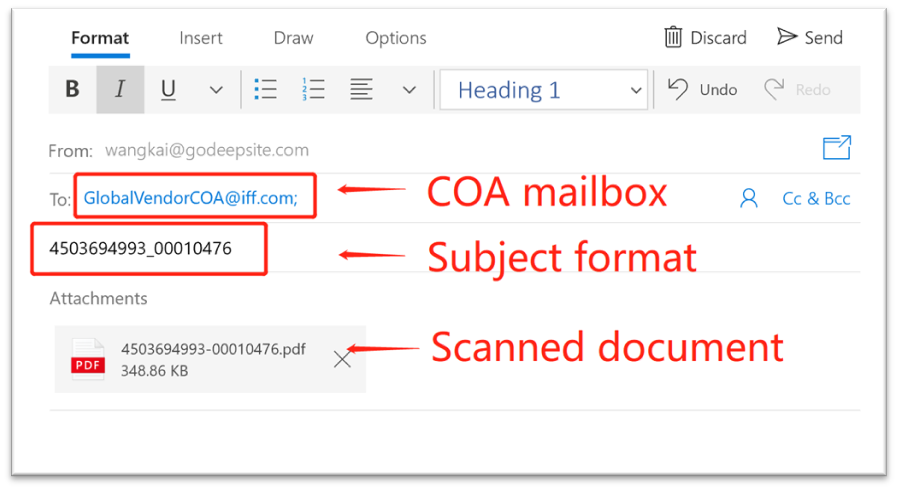
After scanning, users can send the image version or PDF version of scanned copy to the mailbox GlobalVendorCOA@iff.com. Please make sure you have read the Email Limitation and Requirements in section 5 Appendix of this User Guide before sending the mail and write PO#, IPC# clearly in the subject of the email.
3.2 Uploading via Insighter Portal
On the homepage of the Insighter portal, users can click the “Upload COA” button to manually upload the COA documents:
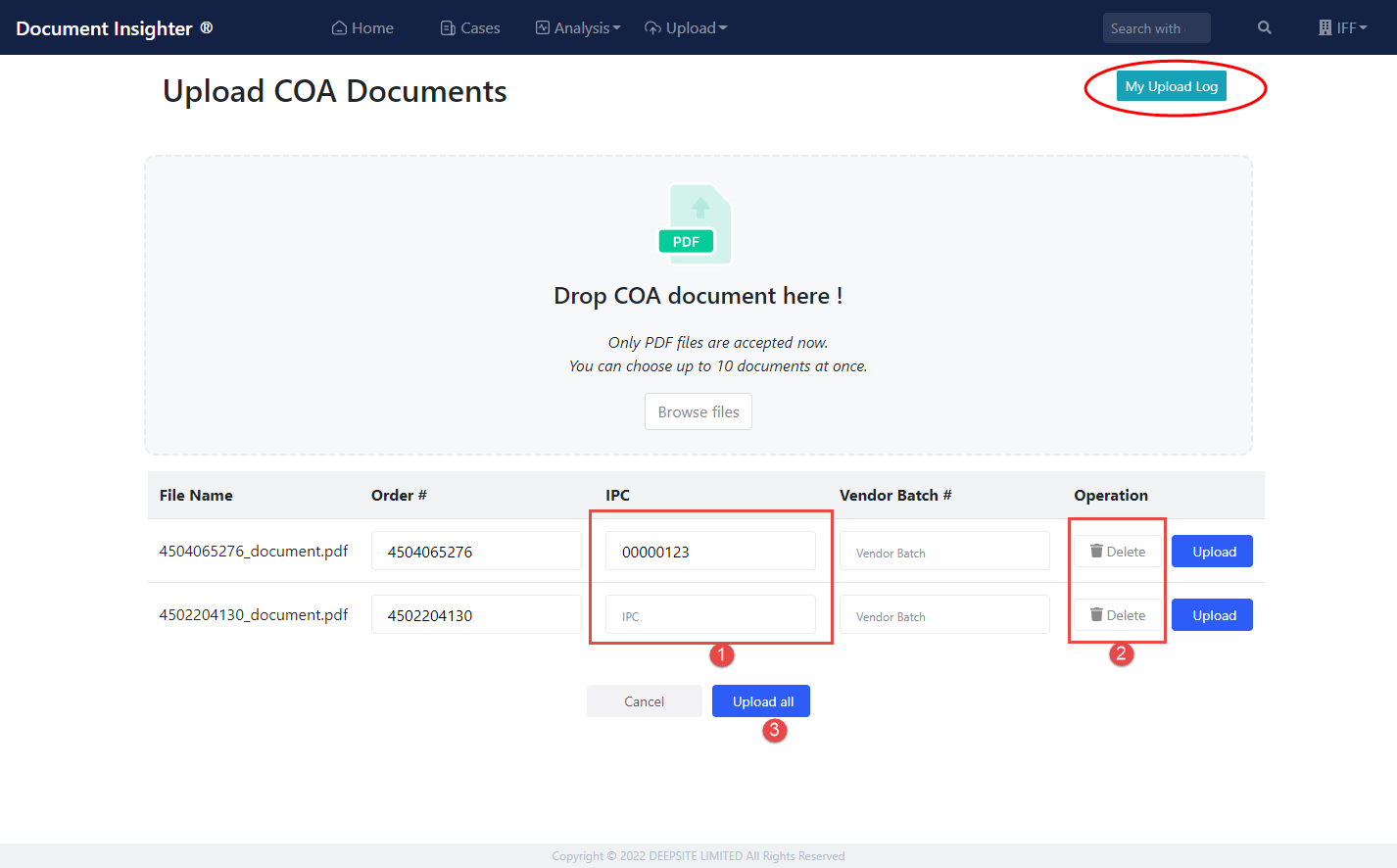
Users can drag or choose the PDF file to upload the document, ① The system will try to extract the PO# and IPC from the title of the file automatically if the title format is “PO#_IPC ”, for example 4500001234_00001234. ② Users can also delete the files from the uploading list. ③ Once the list is ready, click the “Upload” button to complete the uploading process.
Please note that:
- Only PDF files are accepted now.
- Users can choose up to 10 documents at once.
- The system tries to read order #, IPC, and batch # from the document automatically. If the above information is not present in the document, please fill them in the list below.
3.3 Check Uploaded Files Stauts
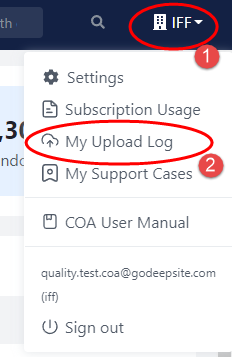
On the homepage of the Insighter portal, users can click the “Account” button, then click “My Upload Log” to review all the process status of COA documents they uploaded before:

Please note that:
- After uploading the file, if the status is “UPLOADED” means that the system has received the document user uploaded sucessfully.
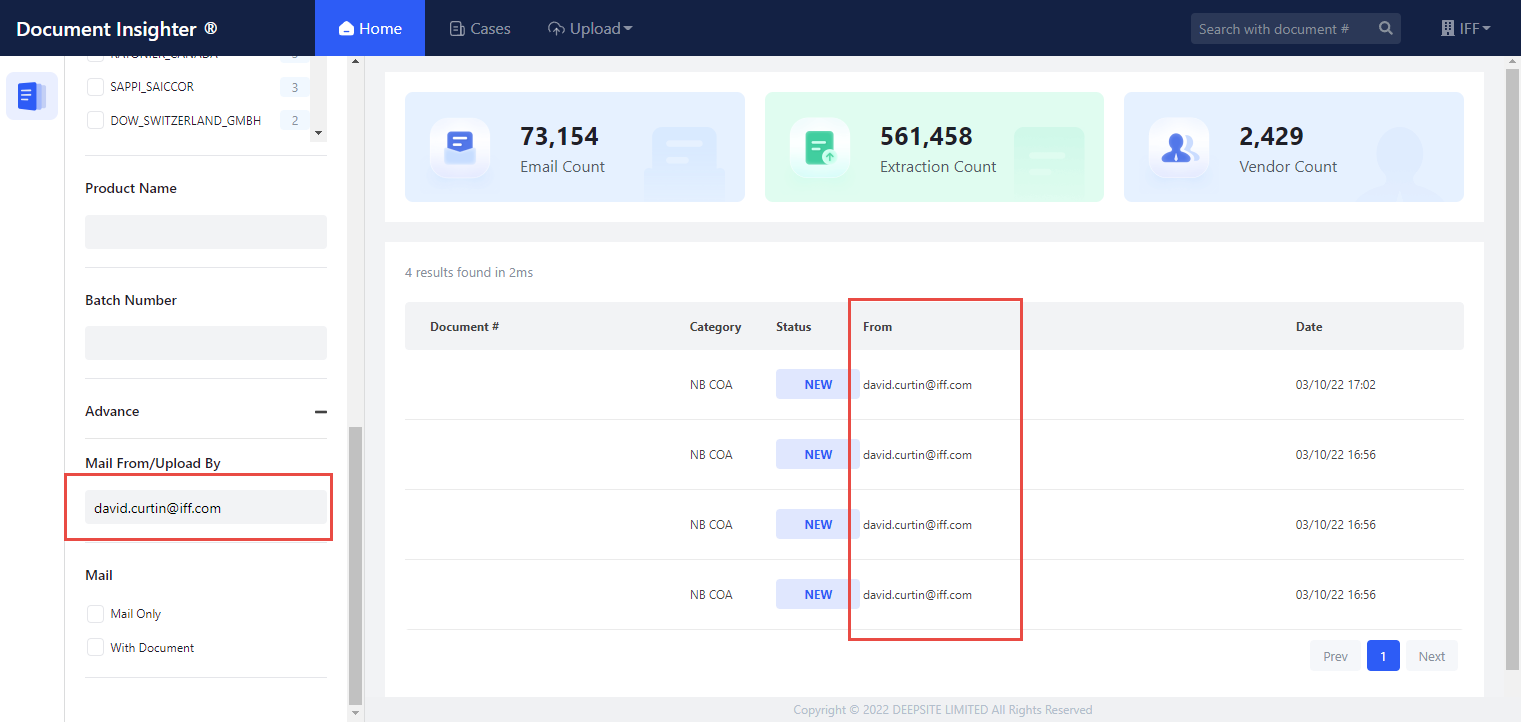
- A moment later(around 5 mins), refresh the page, the status will become “COMPLETED”, users can check and view the processed results through the filtering function on the homepage. Input your email address to check all your uploaded file and the corresponding results:
4 Technical Support
Help desk information including responsible technical contact phone numbers for assistance is currently available at the following period.
- Phone Support: 9:30 – 18:00 HKT, Mon to Fri
- Email Support (service desk connected): 24-Hours as per Section 3.3 of this agreement.
5 Appendix
5.1 Email Limitation and Requirements
- Do not send the same COA document to this mailbox multiple times.
- Please note that globalvendorcoa@iff.com email address is only for COA results extraction. This email address is connected with our automated extracting system. Our colleagues are not checking the query emails here.
- If you have any COA related question or queries, please contact VQ_COO_MRC mailbox.
- Please note that our system can read PDF/JPG/PNG/TIF format and the COA documents should be attached directly to the email. The size of one e-mail can’t exceed 5MB. Our system is not able to open attached emails and Zip folders.
- The recommended email title format for single batch case is: PO number _ IPC number, for example 4500001234_00001234.
- If you would like to submit or email multiple COA documents/PO Numbers/IPC numbers/Batch numbers, please make sure that the PDF document should contain IFF PO number, IFF IPC(Material) Number and Batch Number for each test batch.